A paradox built for exclusion
Hana Young is a student at Phillips Andover Academy and she is is researching neuropsychology at UCSF, designing mental health literacy resources, working in harm reduction in San Francisco’s Tenderloin and developing a pilot for understanding cognitive diversity without reducing people to labels.
She’s also passionate about film & fashion. Follow her on Substack.
Feminine, Predatory, Diseased: A Paradox Built for Exclusion
Legislation and social conditions forced 19th-century Chinese American men into circumstances that were spun into "proof" of their incompatibility with white American society.
Pushed by political unrest back home and pulled by the gold rush and American ideals of freedom and opportunity, Chinese migrants began arriving to the United States in the late 1840s. At first, many were welcomed for their strong work ethic but were soon deemed economic rivals by white gold rush miners. In 1863, construction of the Transcontinental Railroad began and gave Chinese men a legible economic role in American society. They faced dangerous working conditions, inadequate pay, and verbal and physical abuse. Because employers saw them as disciplined and exploitable, some even traveled to China to recruit more workers. But once the project was over, Chinese migrants were quickly recast as economic threats and struggled to find stable work as the economy slowed.
Chinese migrants became scapegoats for the economic decline of the late 1880s, promoted by the use of racial rhetoric such as preserving “racial purity” and “Western civilization” to push for anti-Asian legislation. They faced daily verbal harassment, discrimination, and violence, including the Los Angeles Chinese Massacre of 1871, where a mob of roughly 500 killed at least 18 Chinese immigrants and ransacked Chinese-occupied buildings.
Starting in the late 1800s, Chinese American males were simultaneously characterized as feminine, predatory, diseased, and fundamentally sexually deviant based on the conditions they were confined to. They were cast as fundamentally incompatible with American society. Their image could be reshaped into whatever was most convenient for exclusion and for preserving white masculine dominance. The contradiction was not an accidental flaw in the rhetoric, but what made the portrayal inescapable.
The Page Act
The Page Act of 1875 presumed that Chinese women migrants were in the United States for lewd and immoral purposes, namely prostitution, unless proven otherwise. It was the first law passed to restrict immigration of a specific demographic and justified it as “moral regulation.” The law developed through efforts to prevent Chinese migration and expansion in the US and sexualize Chinese women, and effectively banned Chinese women from immigrating to the United States.
The law did not simply exclude Chinese migrants. By sexualizing Chinese women and restricting family formation, the Page Act helped produce the bachelor communities that were then treated as evidence of Chinese men’s abnormality rather than the result of exclusion itself. By requiring officials to determine whether Chinese immigrants had entered under “immoral contracts,” the law planted the seeds of sexual suspicion around Chinese migration.
White America attributed immorality, dependence, and submissiveness to inherent differences in the Chinese. By excluding Chinese women, the Page Act limited the birth of Chinese Americans, inhibited the growth of their communities, and shifted the gender balance, producing the predominantly male “bachelor” Chinatowns.
Bachelor Societies
There was a myth that the Chinese huddled together to conserve their “alien culture,” but the “bachelor Chinatowns” were products of legislative racism. They faced discrimination that restricted integration, housing, and employment. Chinese male immigrants lived, worked, and socialized together in communities they built. Most were married to women back in China who were banned from joining them.
Their lives in the US were then recast as inherent to their ways of being. Social leaders characterized these communities as filled with “immoral,” “dissolute men” who spent their time gambling, smoking in opium dens, and in brothels exploring their “sexual deviancy.”
According to Michael Park, “Such isolated communities represented the ‘asexualization’ of the Chinese male subject whereby Asian American men were barred from normative heterosexual reproduction and entitlements to community,” which was defined as a monogamous, heterosexual marriage that prioritized reproduction. At the same time, according to Nayan Shah, “Chinese bachelor sexuality is represented as deviant because the presumed sexual relations of these men living in San Francisco were considered nonreproductive and nonconjugal.”
Chinese male bachelors became a sexual and social idea incompatible with white sexual typologies of heterosexual domestic life and homosexual isolation. These conditions prevented them from white American heteronormative domesticity, but because they were not explicitly homosexual, the public had no clean category for them and settled on “deviant.”
Emasculating Work
Legislative exclusion and disenfranchisement created financial instability, and left the men desperate for work. They had no choice but to take jobs primarily associated with women, particularly laundry work, which “feminized” them to the public. A Senate report stated, “The Chinese washerman has taken the place of the white washerwoman. He has usurped the place of the white girl in families.” They were emasculated by the public due to the social and legal constraints they had to live within.
The Servant as Threat
19th Century physician Mary Sawtelle said that Chinese men worked as “chambermaids, house servants, and nurses for Caucasian babies,” claiming that “half of the Chinese servants employed in the families of the wealthy [were] reeking with this venereal virus…They mouth the pap bottle for our innocent little ones.” In Sawtelle’s depiction, the Chinese male housemaid would both clean white families’ houses and simultaneously spread venereal disease, blaming them for syphilis transmission instead of the white parents.
According to Nayan Shah, “Some publications warned mothers of the dangers of unsupervised ‘Chinamen’ who tended white children, ‘particularly little girls.’ These warnings [were] insinuating that Chinese men might sexually molest white girls.” Chinese houseboys were emasculated by the work they had to take, and then cast as sexual predators for doing their job. The roles that Chinese men had to take marked them as subordinate, then were spun into a narrative that made them appear threatening, leaving no neutral position available to them.
When Euro-American males performed similar feminized domestic labor, their masculinity remained intact, even when some would wear women’s clothes or dance with other men. The Chinese American man became the feminized, racialized other that contained gender trouble, against which white masculinity could define itself.
Public health officials, politicians, and travelogue writers emphasized figures of Chinese immorality and infection: the mercenary prostitute who infected white boys and young men with syphilis, the sensuous and depraved “Chinaman” who lured unwitting white men and women into opium dens, and the abject leper who represented the disintegration of the body that would be the fate of American society after years of intimate contact and miscegenation with the Chinese.
Disease Rhetoric
In an 1876 Senate report, San Francisco Police Court Judge David Louderback testified that, “nearly all the boys in town, who have venereal disease, contracted it in Chinatown.” Impressionable young white boys were positioned as victims of Chinese disease and immorality. The Workingmen’s Party pamphlet, “Chinatown Declared a Nuisance!” alleged that “From houses of prostitution, grows and steadily infuses itself slowly but surely an incurable and hereditary curse…Not only the physical condition of our race is endangered, but also the morals of our present and rising generation are corrupted.” People speculated that syphilis was racially inherited.
Opium Dens
Physicians believed that opium dens fostered cross-racial and homosocial intimacy that enabled both physical and moral contamination. They focused on anonymous mouths sucking on the same pipe and exchanging bodily fluids, and sexualized communal smoking, portraying it as an image of promiscuity, queerness, and contamination. “Chinatown Declared a Nuisance!” claimed that, “leprosy, this inherent factor, this inbred disease of Chinese, is infused into our healthy race by the using, the sucking of opium-pipes, which have been handled by those already afflicted.”
Medical officials justified medical discrimination and hospital segregation with this rhetoric, and argued that leprosy’s rampant spread would be inevitable with continued Chinese immigration. They also institutionalized racial stereotypes of immorality and vice into scientific “truth,” including employing “sanitary” mapping, statistics, and surveillance to legitimize oppression and exclusion.
Anti-Miscegenation
Any relations between whites and Chinese, not just marriage, were condemned and demanded to end in the name of cleanliness. White males of “respectable and aspiring” classes were expected to employ strict self-denial and allegiance to social caste to suppress sexual and social desires in order to avoid contact with Chinese males and females. “Chinatown Declared a Nuisance!” demanded “all intercourse cease between Chinese and Americans and vice versa, for sanitary reasons only… Alien to our laws, alien to our religion, alien to our civilization, neither citizen nor desiring to become so, they are a social, moral and political curse to the community.” They also aimed to institutionalize any business or interaction with Chinese as a misdemeanor. Contamination rhetoric translated into legislative action, and eventually anti-miscegenation laws and the Chinese Exclusion Act were passed.
Resistance
However, neither miscegenation law nor authoritative expectations successfully ended or prevented inter-racial relations. Fear of contamination did not dissuade white men from visiting opium dens, families from hiring Chinese house servants, or white women from living with Chinese men or women. This persistence is evident in a series of postcards from 1906 to 1910 depicting the interracial marriage between a Chinese man and white woman, Wong Sun Yue Clemens and Ella May Wong Sun Yue Clemens of San Francisco, which is where most of the discourse circulated. Their shared surname signals the presumed legality of the marriage and public acknowledgement of their shared domestic identity. He is presented as dignified, composed, and masculine, challenging portrayals of Chinese men as sexually deviant and emasculated. Standing side by side, they are framed as equals. The photos are carefully staged to project domestic respectability.
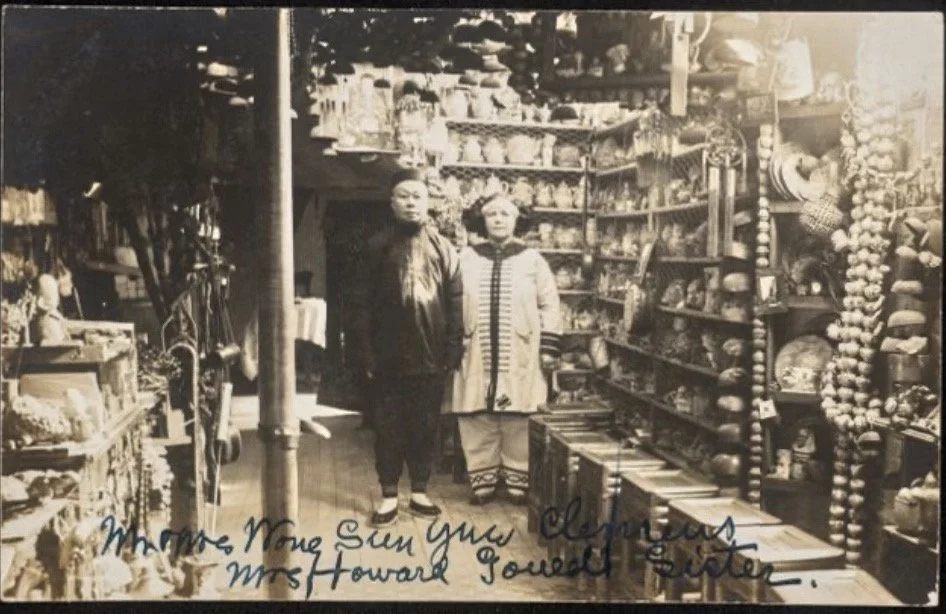
These postcards destabilize the idea that Chinese men could not be in heterosexual domestic relationships, especially ones with women. Despite legal attempts to prohibit inter-racial relationships, Chinese men and white women still pursued relationships, even marriage, and their existence exposed the nature of the discourse. Condemnation on the basis of contamination was not grounded in disease prevention, but racial and sexual control.
What the Contradictions Were For
The deeply paradoxical nature of their characterization of feminine yet predatory, asexual yet deviant, and clean yet infected, shows how public depiction was influenced by what would be most effective for leaders in controlling the population and white male identity. Chinese men reinforced white masculinity by serving as a feminized, inferior, and sexually deviant “other.”
Chinatown introduced whites to social worlds that posed a viable alternative to domestic expectations and white male dominance. They were discriminated against and vilified, which served not only to preserve white supremacy, but also to enforce socio-economic and heterosexual hierarchy within white society itself. According to Nayan Shah, “By contrasting the danger of Chinatown sociability, the white physicians, politicians, and journalists sought to tutor the conduct of wayward white males and inculcate habits of domestic discipline to promote compulsory heterosexual family life.”
Anti-Chinese rhetoric was not only used to justify Chinese exclusion, but also to confine and discipline white Americans. Together, this shows how legislative and medical language can be used to regulate people on all sides, a pattern which shows up far beyond this moment in time.
Why This Feels Familiar
This kind of rhetoric has the power to shape how Chinese men were seen not just by the public, but also by themselves. The conditions they were forced into could be mistaken for their inherent character, and the labels assigned to them could begin to weave into their own sense of self. When people are repeatedly told that their conditions, behaviors, or constrained circumstances reflect something essential about who they are, those external characterizations can become internalized. In that sense, this kind of portrayal risks becoming self-perpetuating: people are excluded, the effects of that exclusion are pathologized or moralized, and those labels then begin to shape identity itself. Even without direct access to private interior life, it is not hard to imagine how a population repeatedly described as inherently immoral, diseased, emasculated, and deviant could begin to experience those labels not just as external judgments, but as pressures on selfhood itself.
What feels so current about this is not the exact historical form, but the mechanism. Labels can be assigned to people before they fully understand themselves, or based on symptoms, conditions, and behaviors, like the ones Chinese men were forced into. Those things can then be pathologized and labeled by others, and those labels can become part of people’s identities, shaping the way they act, view themselves, and imagine what they can and cannot do.
Once I finished writing this, it felt very similar in some ways to my last article on the DSM and its power to shape identity and exert control. The contradiction in how the men were portrayed stood out to me so much. They were portrayed in so many ways that do not even fully make sense together, but in a way that made it so nothing they could do could ever be right. Every direction they could go could be villainized.
Sources
Abrams, Kerry. “Polygamy, Prostitution, and the Federalization of Immigration Law.” Columbia Law Review 105, no. 3 (2005). https://scholarship.law.duke.edu/cgi/viewcontent.cgi?article=6520&context=faculty_scholarship.
California Senate. Chinese Immigration: The Social, Moral, and Political Effect (1876). https://archive.org/details/chineseimmigrati00cali/page/n5/mode/2up.
Kytka, John. Postcard Photographs of Ella May Wong Sun Yue Clemens and Wong Sun Yue Clemens. 1906-1910. Photographs. General Manuscripts Miscellaneous Collection, C0140, Manuscripts Division, Department of Special Collections, Princeton University Library. https://findingaids.princeton.edu/catalog/C0140_c23965-16345.
Park, Michael. “Asian American Masculinity Eclipsed: A Legal and Historical Perspective of Emasculation Through U.S. Immigration Practices.” The Modern American 8, no. 1 (2013). https://digitalcommons.wcl.american.edu/cgi/viewcontent.cgi?article=1164&context=tma.
Sears, Clare. “All that Glitters: Trans-ing California’s Gold Rush Migrations.” GLQ: A Journal of Lesbian and Gay Studies 14, no. 2 (2008). https://muse.jhu.edu/article/241322.
Shah, Nayan. Contagious Divides. Reprint ed. Berkeley: University of California, 2001. https://www.perlego.com/book/1584629.
United States Congress. An Act Supplementary to the Acts in Relation to Immigration (Page Act of 1875). 43rd Congress. 2nd session. chapter 141. (March 3, 1875). https://loveman.sdsu.edu/docs/1875Immigration%20Act.pdf.
Workingmen’s Party of California. Chinatown Declared a nuisance! San Francisco, 1880. https://sfmuseum.org/hist2/nuisance.html.